$25.00Original price was: $25.00.$20.00Current price is: $20.00.
The Complete Guide to Miniature Waterfowl: Sourcing Elite Call Ducks for Sale for Natural Pest Control and Bantam Charm
For backyard flock curators, artisanal homesteaders, and ornamental waterfowl enthusiasts nationwide, introducing small-scale waterfowl is an exceptional way to diversify a property. Just as managing a high-performance apiary requires selecting resilient, gentle biological genetics for your hives, growing your poultry yard depends on choosing the right foundational livestock. Among the miniature or bantam waterfowl varieties, none command as much popularity, curiosity, and pure delight as the iconic Call duck.
At Golden Hive Farm, our dedication to sustainable agriculture and natural ecosystems drives every resource we create. While our core mission centers on crafting elite woodenware and sourcing premium biological essentials for pollinators, we view the modern homestead as an integrated cycle—where active waterfowl and industrious honeybees work together to cultivate thriving land. Together with our agricultural partners at Grassfield Homestead, we have built this structural blueprint to help you evaluate, house, and manage these miniature marvels. In this guide, we will break down the history, breed standards, and specialized care requirements you need to know when looking for premium Call ducks for sale to elevate your farm.
1. The History and Practical Evolution of Decoy Waterfowl
To understand why experienced poultry keepers actively look for high-quality Call ducks for sale to add to their setups, one must look at the unique history of this bantam breed. Originating in the Netherlands during the 17th century, these miniature birds were originally known as “Coy” or “Decoy” ducks.
+-----------------------------------+
|     Historic Dutch Coy Ducks      |
+-----------------------------------+
                  |
                  v  (Selected for high-frequency vocal resonance)
+-----------------------------------+
|      The Commercial Decoy Era     |
|   - Used by hunters to lure wild  |
|     mallards into funnel traps    |
+-----------------------------------+
                  |
                  v  (Imported to UK & US; refined for exhibition)
+-----------------------------------+
|      Modern Bantam Call Duck      |
|   - Distinctly compact, round body|
|   - Outstanding garden pest hunter|
+-----------------------------------+
Unlike most modern bantam chickens, which were bred down from larger counterparts, Call ducks were developed for a highly specific commercial and hunting purpose. Their small size made them easy to transport, and they were selectively bred for their remarkably loud, high-frequency voices. Hunters tied these little ducks near traps or blinds; their frequent, piercing calls successfully lured wild mallards out of the sky. When synthetic mechanical decoys and changing hunting regulations emerged in the 19th and 20th centuries, the breed smoothly transitioned into a beloved fixture of competitive exhibition halls and backyard orchards.
2. Breed Standards and Physical Characteristics of Call Ducks
When reviewing online hatchery availability, searching for a local duck hatchery near me, or visiting specialized breeders to evaluate Call ducks for sale, knowing the official physical traits ensures you are investing in authentic, healthy, and pure-bred bantam stock.
Compact Geometry and Silhouette
The Round Silhouette: The ideal Call duck looks remarkably like a small, smooth tennis ball with a head. They possess short, thick, and compact bodies, a deep round breast, and short necks that blend smoothly into their shoulders.
The High-Dome Head: Their heads are round and high-domed with chubby, prominent cheeks. Their eyes are large, bright, and set almost perfectly in the center of the head.
The Stubby Bill Advantage: A defining trait of purebred Call ducks is their exceptionally short, broad, and slightly flattened bill. A long, slender bill is a major structural fault, indicating cross-breeding with standard mallards or larger duck breeds.
True Bantam Mass: These are the smallest domestic ducks available. Mature drakes (males) typically weigh only 20 to 26 ounces ($550$ to $750\text{ g}$), while mature ducks (females) average a tiny 16 to 22 ounces ($450$ to $600\text{ g}$).
Popular Color Varieties
While the classic pure white variety remains a timeless favorite for exhibition, decades of heritage breeding have established a wide range of beautiful, recognized color patterns:
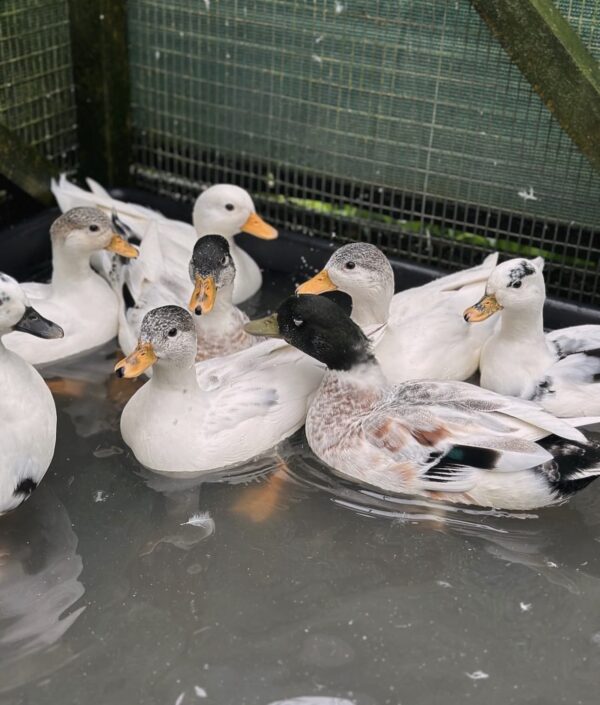
White: Solid, snow-white feathers paired with bright orange bills and legs.
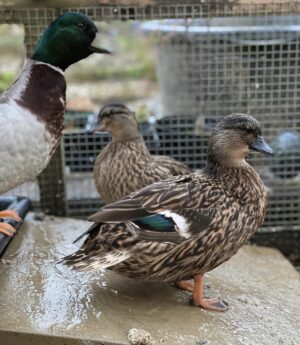
Gray: A beautiful wild-type pattern that mirrors the exact coloration of standard wild Mallards.
Pastel: A soft, dilute variation featuring creamy-tan hues and silver-grey shading.
Butterscotch: A striking mix of rich apricot-gold tones highlighted by crisp white markings.
3. Behavioral Traits: High Energy and Vocal Communication
Beyond their undeniable visual appeal, understanding the behavioral traits of Call ducks is essential for integrating them comfortably into your neighborhood or farm environment.
True to their historic roots, female Call ducks are incredibly vocal. They possess a loud, rapid, and enthusiastic quack series—often referred to as a “lonesome plug”—which they repeat frequently throughout the day to communicate with their flock or greet their keepers.
Drakes, on the other hand, produce only a soft, raspy, low-whisper quack. Because the females carry so well across distances, they are perfect for rural farms but may not be ideal for tight suburban spaces with strict noise ordinances.
Flight Capability and Foraging Agility
Unlike heavy domestic ducks like Pekins or Rouens, Call ducks are incredibly lightweight and retain excellent flight capabilities. They can easily clear a standard 6-foot fence and fly out of your yard if startled.
To keep them safe, house them within a fully enclosed, top-netted run, or have a professional gently clip the flight feathers of one wing during their annual summer molt. When allowed to forage safely, they act as elite organic pest control units, clearing out slugs, snails, mosquito larvae, and beetles from your garden without stamping down your delicate plants or digging up roots.
4. Production Dynamics and Specialized Breeding Realities
When purchasing young ducklings or breeding pairs from commercial listings of baby ducks for sale, understanding their reproduction cycle helps you manage your flock effectively.
Seasonal Egg Production
Call ducks are strictly seasonal layers. Instead of producing continuously through the year like chickens, they lay their eggs primarily in the spring, from late March through June. A healthy female will produce roughly 50 to 80 small, white-to-pale-green eggs per year. They possess incredibly strong maternal instincts and will readily sit on a nest, fiercely protecting their clutch for the full 26-day incubation period.
Because of their extreme bantam features, breeding Call ducks requires patience. The genetic mutation that creates their beautifully short, stubby bills makes it structurally difficult for ducklings to maneuver inside the shell and pip cleanly during hatch week.
As a result, their natural hatch rates are often lower than standard duck breeds. Successful breeders routinely use digital incubators to precisely manage humidity levels ($45\%$ to $55\%$ during incubation, bumping up to $65\%$ to $70\%$ during lockdown) to assist these miniature ducklings.
5. Sustainable Infrastructure: Designing the Perfect Waterfowl Habitat
Because of their small frames and high metabolism, Call ducks need proper housing setups to keep them safe from predators and secure from escape. For complete layout designs and dimensions, check out the resources over at Grassfield Homestead.
Structural Component
Minimum Requirement per Bird
Design Purpose
Indoor Floor Space
4 sq. ft.
Prevents moisture buildup and keeps their bedding clean and dry.
Exterior Run Space
8-10 sq. ft.
Gives them plenty of space to stretch their wings, run, and forage.
Enclosure Protection
$\frac{1}{2}$-inch hardware cloth with top netting
Prevents escapes and keeps out agile climbing predators like raccoons.
Water Access Depth
4-6 inches minimum
Allows them to submerge their entire bill and head to clear their eyes and nostrils.
Water Access Management
While Call ducks do not require a massive, deep pond to stay happy, they absolutely need daily access to clean, open water. Ducks use water to rinse out their eyes, clean their nostrils, and properly digest their food.
A heavy, shallow rubber livestock pan or a simple plastic step-in wading pool works beautifully for small bantams. Ensure the pool has a shallow, non-slip ramp so these short-legged ducks can hop in and out safely without getting trapped or exhausted.
6. Sourcing Tips: Evaluating Commercial Hatcheries and Breeders
When looking to buy Call ducks for sale, your sourcing strategy will depend on your long-term goals for your flock.
Commercial Hatcheries: Sourcing through a large poultry hatchery or ordering ducklings for sale online is highly efficient if you are looking for active, energetic backyard pets or garden pest hunters. Hatcheries routinely ship day-old ducklings via USPS priority mail safely to your local post office.
Specialized Preservation Breeders: If your goal is to breed purebred lines or enter competitive exhibition halls, look for specialized, local heritage breeders through waterfowl associations. This ensures your birds possess the ultra-short bills, high-domed heads, and precise color patterns required by standard judging criteria.
7. Trusted Waterfowl and Heritage Organizations
To learn more about waterfowl genetics, disease prevention, and integrated small-farm management, consult these leading agricultural research extensions and preservation organizations:
Poultry Associations & Research Extensions
The Livestock Conservancy: A premier non-profit organization dedicated to protecting historic, endangered livestock and poultry breeds to preserve genetic diversity.
The American Poultry Association (APA): The official governing body responsible for maintaining breed classifications and standard judging criteria across North America.
8. Build a Balanced Homestead with Golden Hive Farm
Cultivating a resilient homestead is all about understanding and working with natural systems. By pairing the intense, low-impact pest control power of miniature Call ducks with the seasonal pollination power of healthy honeybee colonies, you create a sustainable, self-reinforcing cycle that brings life and abundance to your land.
At Golden Hive Farm and Grassfield Homestead, we are committed to providing you with the high-quality gear, elite apiary setups, and expert guidance needed to help your homestead thrive. Explore our complete selection of premium hives, protective equipment, and educational guides today, and discover how bringing quality, care, and structural precision to your land can transform your harvest for seasons to come!
Reference Manual Architecture
American Poultry Association. (2010). The American Standard of Perfection. American Poultry Association, Inc.
Holderread, D. (2011). Storey’s Guide to Raising Ducks: Breeds, Care, Health. Storey Publishing, LLC.
The Livestock Conservancy. (2023). Heritage Poultry Breeding and Selection Manual. The Livestock Conservancy Publications.
Seeley, T. D. (2019). The Lives of Bees: The Untold Story of the Honey Bee in the Wild. Princeton University Press.

Reviews
There are no reviews yet.